Ninety seconds.
One number.
Both eyes.
POLI runs at intake. By the time your patient sits down with you, their macular sensitivity score is already on screen. You triage before the slit lamp comes out.
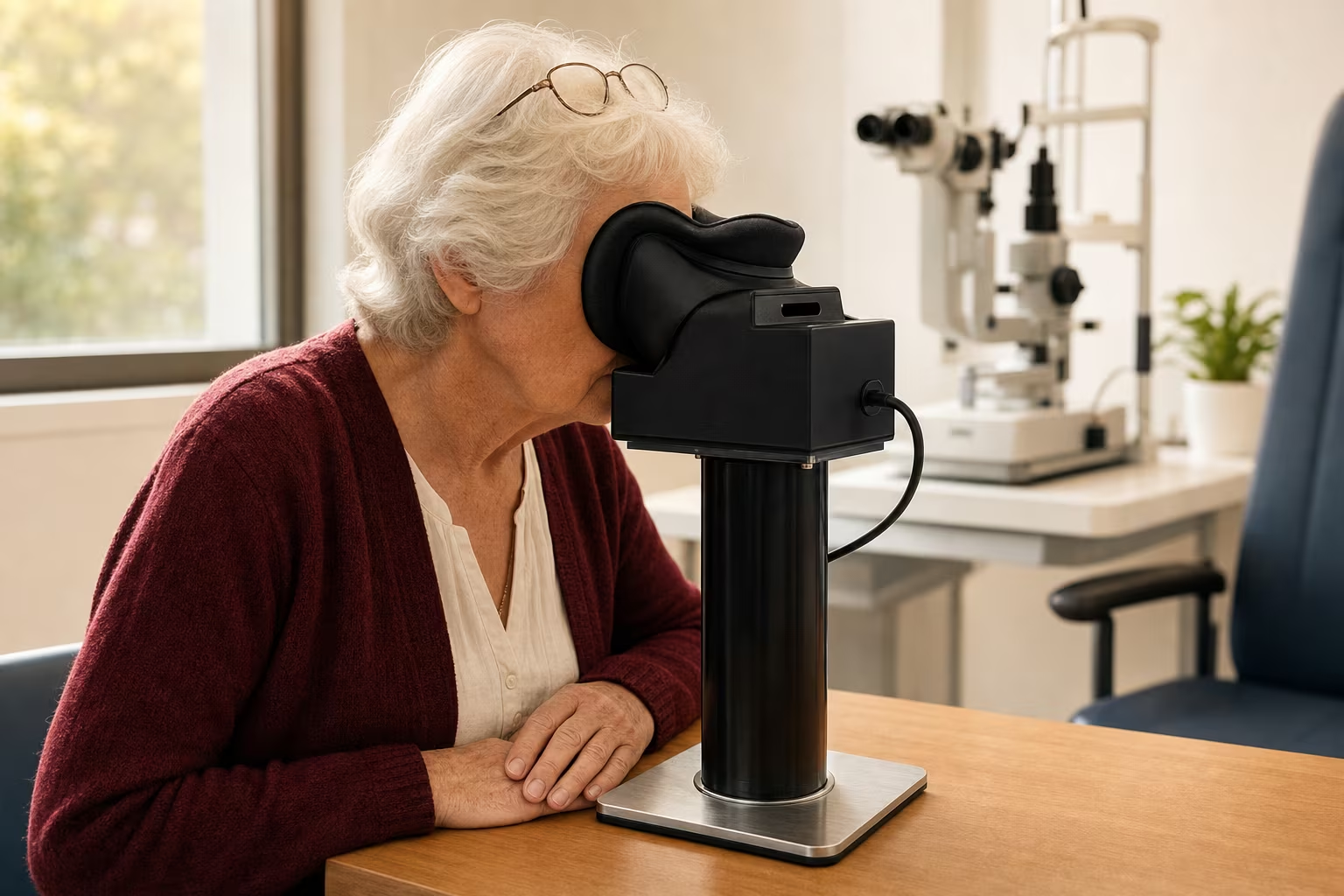
What POLI does, step by step.
POLI flashes calibrated light at points across the macula. The patient presses a button each time they see one, and every press locks in a sensitivity reading. The full map prints with the rest of the exam.

1 · Light goes in
Calibrated flashes hit specific points on the macula. No drops. No dilation. Room lights stay on.
2 · The patient responds
One button. They press when they see a flash. Each press locks in a sensitivity reading for that spot.
3 · The score prints
One number for the chart. A heat-map for the conversation. Comparable across patients and across visits.
Where POLI sits in a 30-minute appointment.
POLI runs while the patient is at intake. By the time you sit down with them, the score is already in their chart.
Treatments for early AMD exist.
Adoption is limited by what cannot be measured.
Photobiomodulation and microcurrent stimulation are now in roughly 400 clinics across North America. Patient uptake stays low. Those who start tend to drop off within six months.
The reason is the same in both cases. Without a quantified macular measurement, the clinician cannot prove the therapy is working, and the patient cannot see a reason to stay on it. POLI gives both sides a number they can track from one visit to the next.

Patient is screened
POLI quantifies macular sensitivity. The clinician has a number that says "this retina is changing." No interpretation, no specialist referral.
Treatment is recommended
Photobiomodulation, microcurrent, lifestyle protocols. The clinic explains the score and what improvement would look like.
Patient stays on plan
Every follow-up visit shows the score moving. The patient sees the proof. The clinician sees the proof. The therapy keeps going.
Questions clinicians ask.
Is POLI a regulated medical device?
Yes. POLI is being approved as a Class I medical device under FDA general controls and Health Canada equivalent. Class I devices are exempted from premarket approval and do not require a 510(k) submission for the intended measurement use.
What exactly does it measure?
POLI quantifies macular sensitivity, the threshold at which photoreceptors in defined retinal locations respond to a controlled light stimulus. A decline in this metric precedes structural change visible on OCT by years. STUB · confirm clinical wording with Connor
How long does a measurement take?
Under two minutes for a full test, both eyes. POLI is designed to live at the front desk of a clinic, not in a specialist's back room.
Who operates it?
Any trained optometric assistant. No specialist sign-off required. The Class I designation means the device does not change the staffing or certification footprint of your practice.
How does the readout integrate with my charting system?
POLI exports a structured readout, including the composite sensitivity score and per-region map, as PDF and CSV. EMR integration is on the 2026 roadmap. STUB · confirm export format and EMR plans
Who is POLI for?
Optometrists and ophthalmologists. POLI is built for everyday clinical workflow, not specialist referral environments.
Where are you based?
Waterloo, Canada. Mandel is part of the Velocity incubator and was incubated out of the University of Waterloo's retinal research labs.
Bring POLI to
your clinic.
Tell us about your practice. We will follow up with pilot details, or reach our team directly using the addresses below.